Six months ago, a founder got on a call with us at Deveote. He was panicking. His startup had raised a pre-seed round, built a working prototype, and landed three paying customers. On paper, everything was on track. In reality, his company was falling apart, because his technical co-founder had stopped showing up.
The co-founder, a talented full-stack developer with an impressive GitHub profile, had taken a remote contract with a European fintech that paid three times what the startup could afford. He hadn't formally resigned. He was just ... no longer there. The code was half-finished. The equity was fully vested (they'd skipped the cliff). And the founder was stuck with a ghost on his cap table and a product he couldn't ship.
This story is not unusual. It is, in fact, the most common version of startup failure that nobody writes about.
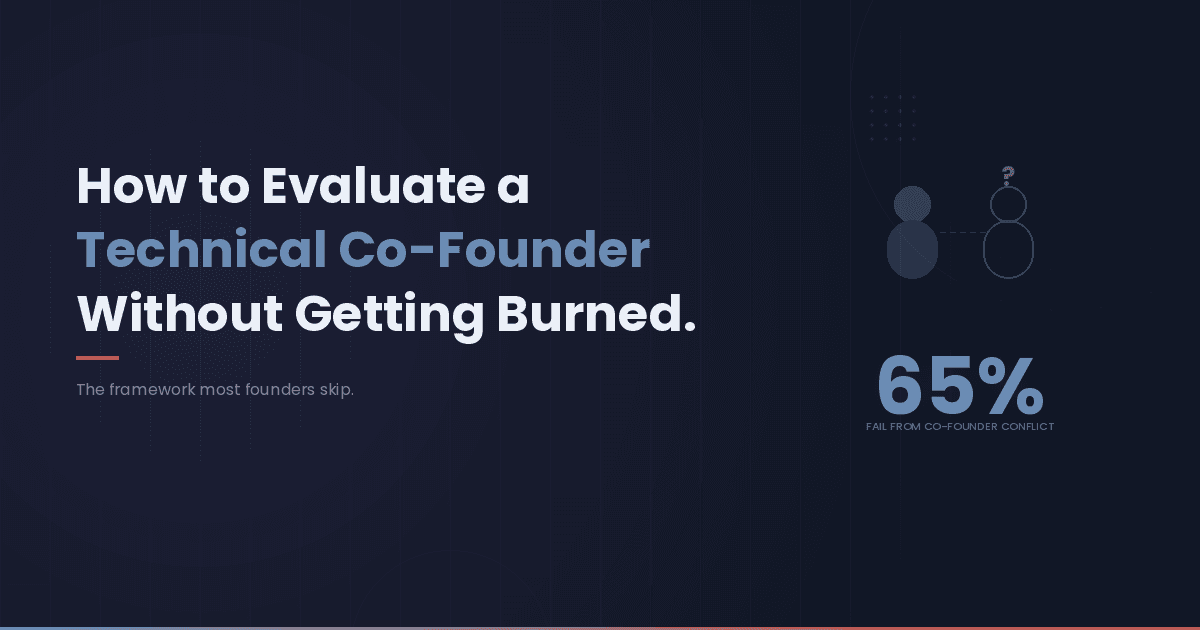
Noam Wasserman, a Harvard Business School professor who studied nearly 10,000 founders over a decade, found that 65% of high-potential startups fail due to conflict within the founding team. Not because the market wasn't there. Not because the technology didn't work. Because the people at the top couldn't hold it together.
The problem isn't that founders don't evaluate their technical co-founders. It's that they evaluate the wrong things. They test for coding ability when they should be testing for character. They negotiate equity when they should be negotiating expectations. They rush into partnerships that should take months to prove out, because they're afraid of building alone.
This article offers a different approach: a structured framework for evaluating a technical co-founder across the three dimensions that actually predict whether a founding team will survive, Competence, Character, and Commitment. It also asks a question most co-founder advice skips entirely: do you actually need a co-founder, or is there a better option for your stage?
Why the Standard Evaluation Approach Fails
Most founders evaluate a potential technical co-founder the way they'd evaluate a senior hire: portfolio review, technical interview, maybe a take-home assignment. They're checking whether this person can build the product. That question matters, but it's the wrong first question.
A technical co-founder is not an employee. They're a partner. They'll have opinions about what to build, when to ship, who to hire, and how much risk to take on. If your evaluation process doesn't surface how they think about those decisions, you're testing for the wrong skills.
The 'Best Coder' Trap
At Deveote, we've seen this pattern repeatedly in the startups we advise: a founder finds the most technically impressive person they can, gives them a co-founder title, and assumes the partnership will work because the code is good. It rarely does.
The best coder in the room is not automatically the best co-founder. In fact, highly skilled engineers who haven't worked in startup environments often bring habits that actively hurt early-stage companies. They over-architect. They optimize for elegance instead of speed. They build for imagined scale when you need to test with 50 users. As one analysis puts it, "premature CTOs often build for imagined scale, locking the product into rigid infrastructure" before you even know whether anyone wants what you're building.
The Title Inflation Problem
Another common mistake: giving the CTO title (and significant equity) to someone simply because they're the first technical person willing to join. Research from funded.club estimates that a CTO mis-hire costs between 5 and 27 times their annual salary. At an average startup CTO salary of $157,000, that puts the true cost of getting this wrong well into seven figures. And that's just the financial cost. The lost time, team morale damage, and cap table complications can set a startup back by a year or more.
The Friends and Family Fallacy
Wasserman's research reveals something counterintuitive: founding teams made up of friends, family members, or romantic partners fail more often than teams of professional acquaintances. The reason is straightforward. People with personal relationships avoid the hard conversations, the ones about equity, about who's underperforming, about whether the strategy is working, because they don't want to damage the relationship. By the time they finally have those conversations, it's too late.
The Three Cs Framework
After years of evaluating founding teams, first at Future Africa and Accelerate Africa where I reviewed hundreds of startup applications, and now at Deveote where we advise founders on technical partnerships, I've distilled the evaluation into three dimensions. I call them the Three Cs: Competence, Character, and Commitment.
Each dimension has specific signals you can test for, and specific red flags that should make you walk away.
Competence: Can They Build What You Actually Need?
Competence is not about raw technical skill. It's about whether this person can make the right technical decisions for your startup at its current stage.
What to evaluate:
Stage-appropriate architecture thinking. Ask them to describe how they'd build your MVP. If they start talking about microservices, Kubernetes clusters, and event-driven architecture for a product with zero users, that's a red flag. You want someone who says: "We'll start with a monolith, use a managed database, deploy to a single cloud region, and refactor when we have real usage data."
Decision-making under constraints. Give them a real scenario: "We have $30,000 in runway for development and need to launch in 8 weeks. Here's the feature list. What do you cut?" How they answer tells you whether they think like a startup builder or a big-company architect.
Learning velocity over current knowledge. Technology changes fast. A co-founder who's an expert in one stack but can't adapt is less valuable than someone with strong fundamentals who picks up new tools quickly.
Red flag: They can't explain their technical decisions in plain language. If your technical co-founder can't translate architecture choices into business impact for you and your investors, you'll be flying blind on technical decisions for the life of the company.
Character: How Do They Handle Pressure?
Character is what separates a good engineer from a good co-founder. Building a startup is a prolonged exercise in handling ambiguity, disagreement, and failure. You need to know how this person operates when things go wrong.
The trial project method. Before committing to a co-founder arrangement, work together on a defined project for 4 to 6 weeks. This is not a technical audition. It's a compatibility test. NYU's Entrepreneurial Institute recommends this approach because it reveals how someone handles communication, setbacks, and collaborative decision-making in ways a conversation never can.
What to watch for during the trial:
How they disagree. Do they shut down, get defensive, or engage constructively? You're going to disagree about product direction, hiring, fundraising strategy, and a hundred other things. The quality of those disagreements determines whether the partnership survives.
How they handle being wrong. Everyone makes bad calls. What matters is whether they acknowledge mistakes quickly and adjust, or whether they dig in and defend bad decisions.
How they communicate when blocked. A co-founder who disappears when they hit a problem is far more dangerous than one who hits problems frequently but communicates about them.
Red flag: They're dismissive of your non-technical contributions. If they treat business development, customer research, or fundraising as "the easy stuff," you're looking at a partnership where your contributions will be consistently undervalued.
Commitment: Are They All In?
Commitment is the dimension that kills the most African startup partnerships. With 38% of African developers now working remotely for international companies, the opportunity cost of joining an early-stage startup is enormous. A senior developer in Lagos can earn $60,000 to $100,000+ from a European or American remote employer. Your startup probably can't match that, at least not in cash.
What to evaluate:
Financial runway. Do they have enough savings or alternative income to sustain themselves during the lean months? If they're relying on the startup for immediate income it can't provide, they'll leave when a better-paying offer comes.
Side project inventory. Ask directly: what else are you working on? A technical co-founder with three freelance clients and a side project is not a co-founder. They're a part-time contractor with a fancy title.
Skin in the game. Are they willing to vest their equity over 4 years with a 1-year cliff? If someone resists standard vesting terms, that tells you something important about how committed they expect to be.
Red flag: They want to keep their full-time job "just for a few months" while co-founding your startup. In our experience, those few months almost always become permanent.
Getting the Equity Conversation Right
Equity splits are where co-founder relationships either get a solid foundation or plant the seeds of future conflict.
Data from Carta shows that among two-co-founder startups, 38.8% split equity equally. The trend is moving toward more equal splits: the median went from 60/40 in 2019 to 51/49 in 2024. But equal splits are not automatically fair, and fair splits are not automatically equal.
Here's a practical framework:
If you're both starting from zero (no traction, no customers, no capital invested), an equal or near-equal split makes sense. Both co-founders are taking the same risk.
If you've already built traction (paying customers, a prototype, capital raised), the split should reflect the different risk profiles. You've de-risked the venture; your technical co-founder is joining something that already has value. A 60/40 or 55/45 split (favoring the founder who built the initial traction) is reasonable.
Regardless of the split, use standard vesting. Four-year vesting with a one-year cliff is industry standard for good reason: it protects both parties. If either co-founder leaves in the first year, they walk away with nothing. After that, equity vests monthly. This is not a sign of distrust. It's a sign that you're both serious enough to earn your ownership over time.
Skip the vesting conversation, and you end up like the founder I described at the top of this article: stuck with a ghost on your cap table who owns a chunk of your company and contributes nothing.
You Might Not Need a Co-Founder at All
Here's a question most co-founder advice doesn't ask: do you actually need a technical co-founder right now, or do you need technical leadership in a different form?
The startup world treats co-founders as a binary: either you have one or you don't. But technical leadership exists on a spectrum, and matching the right option to your stage can save you from the co-founder trap entirely.
CTO-as-a-Service ($3,000/month). This model has quietly become the default for funded startups and bootstrapped SaaS companies that need strategic technical leadership without the cost or commitment of a full-time CTO. For a monthly retainer, you get weekly strategy sessions, architecture reviews, team hiring support, vendor selection guidance, and on-call technical decision-making. The economics are compelling: roughly 20% of the cost of a full-time CTO, zero equity dilution, and access to cross-industry experience that a single in-house hire rarely brings. At Deveote, our CTO-as-a-Service works exactly this way: founders get senior technical leadership on their terms, from architecture planning to code quality oversight, without giving up equity or locking into a co-founder relationship they're not ready for.
Senior individual contributor. If your primary need is someone to build the product (not set strategy), hire the best senior developer you can afford. Give them a strong salary, a reasonable equity grant (not co-founder level), and let them build. You retain control and can bring in strategic leadership later.
Technical advisory board. For $0 to modest equity grants (0.25% to 0.5%), experienced CTOs will advise you on major technical decisions without the commitment or cost of a full-time role. This works well when you have a competent development team but lack strategic technical oversight.
The right choice depends on your stage. Pre-revenue? You probably need a builder (senior IC or development partner), not a strategist. Post-product-market-fit with a growing team and real architectural complexity? That's when CTO-level leadership, whether through a co-founder, a CTO-as-a-Service arrangement, or a full-time hire, starts earning its keep.
The Evaluation Checklist
If you do decide a technical co-founder is the right move, run through these checks before committing:
Before the first meeting:
Define exactly what "technical co-founder" means for your startup. Write down the top 5 technical decisions you'll need to make in the next 12 months. If your candidate can't speak credibly to at least 3 of them, they're not the right fit.
During the trial project (4 to 6 weeks):
Track response times to messages. Note how they handle the first real disagreement. Observe whether they propose solutions or just identify problems. Check whether they write documentation or just code. Watch whether they ask about users and business context, or only about technical requirements.
Green flags:
They push back on your ideas with better alternatives. They ask about your customers before asking about your tech stack. They set realistic timelines and hit them. They flag risks early instead of hiding them. They're excited about the problem, not just the technology.
Red flags that should stop the conversation:
They refuse to do a trial project because they "don't work for free." (A trial project is not free work; it's mutual due diligence, and it protects them as much as it protects you.) They can't name a project they've failed at and what they learned. They want the co-founder title before understanding the business. They resist vesting terms. They badmouth every previous team they've worked with.
The Partnership You Actually Need
That founder who called us six months ago? He never found another co-founder. He didn't need to. We brought him onto our CTO-as-a-Service program instead. Our team took over the half-finished codebase, made the architecture decisions that his ghost co-founder had been avoiding, and shipped the product within two months. From there, we helped him hire two solid engineers, set up their development workflow, and managed the engineering team's output while he focused on sales and fundraising. His three customers became twelve, then twenty-five. The product is live, growing, and he still owns 100% of the equity that matters.
The best technical co-founder is not necessarily the best coder. It's the person who makes you and your startup better under pressure, someone who fights for the product, tells you when you're wrong, and stays when things get hard. That person is worth an equal equity split and then some.
But if you haven't found that person yet, don't settle for a warm body with a GitHub account. The cost of the wrong co-founder is almost always higher than the cost of building without one for a while longer. Take the time. Run the framework. Protect your cap table. And if you need technical leadership in the meantime, there are better options than a premature partnership.